

Hair Loss - Patients ask, Dr. Ringpfeil answers
Please feel free to use the blog below to share information about Hair Loss or to ask Dr. Franziska Ringpfeil a question that might be of interest to others.
Hair loss is a common medical condition especially on the head (baldness) in men. Hair loss generally occurs as hair thinning and progresses to complete hair loss on major areas of the body such as legs, arms, back, and scalp. Although most people assume only men lose their hair, front scalp hair loss affects 58% of women and 75% of men. The common term for frontal baldness is "receding hairline" and typically advances to the mid to back of the head in male pattern baldness.
Hair loss may occur because of various situations or medical factors. The term "Traction Alopecia" refers to hair loss induced by a person who pulls frequently on the hair. The same loss of hair can be induced by extreme force from a hairstyle such as cornrows or ponytails. Generally, hairstyles do not cause the loss of hair by themselves but if coupled with weak roots can contribute to mild baldness. Medical treatments such as chemotherapy or radiation, which severely weakens the body, are usually responsible for rapid and severe hair loss and may result in complete baldness. The hair often returns after the treatment stops. Individuals with hyperthyroidism also complain of patchy hair loss on the head, arms, and legs. Malnutrition, specifically lack of protein in the diet, often leads to thinning hair. Hair requires extensive protein use so without proper nutrition, the body cannot grow hair. Lastly, fungus infections of the hair follicle called folliculitis and ringworm infection of the scalp cause production of brittle hair that falls out easily.
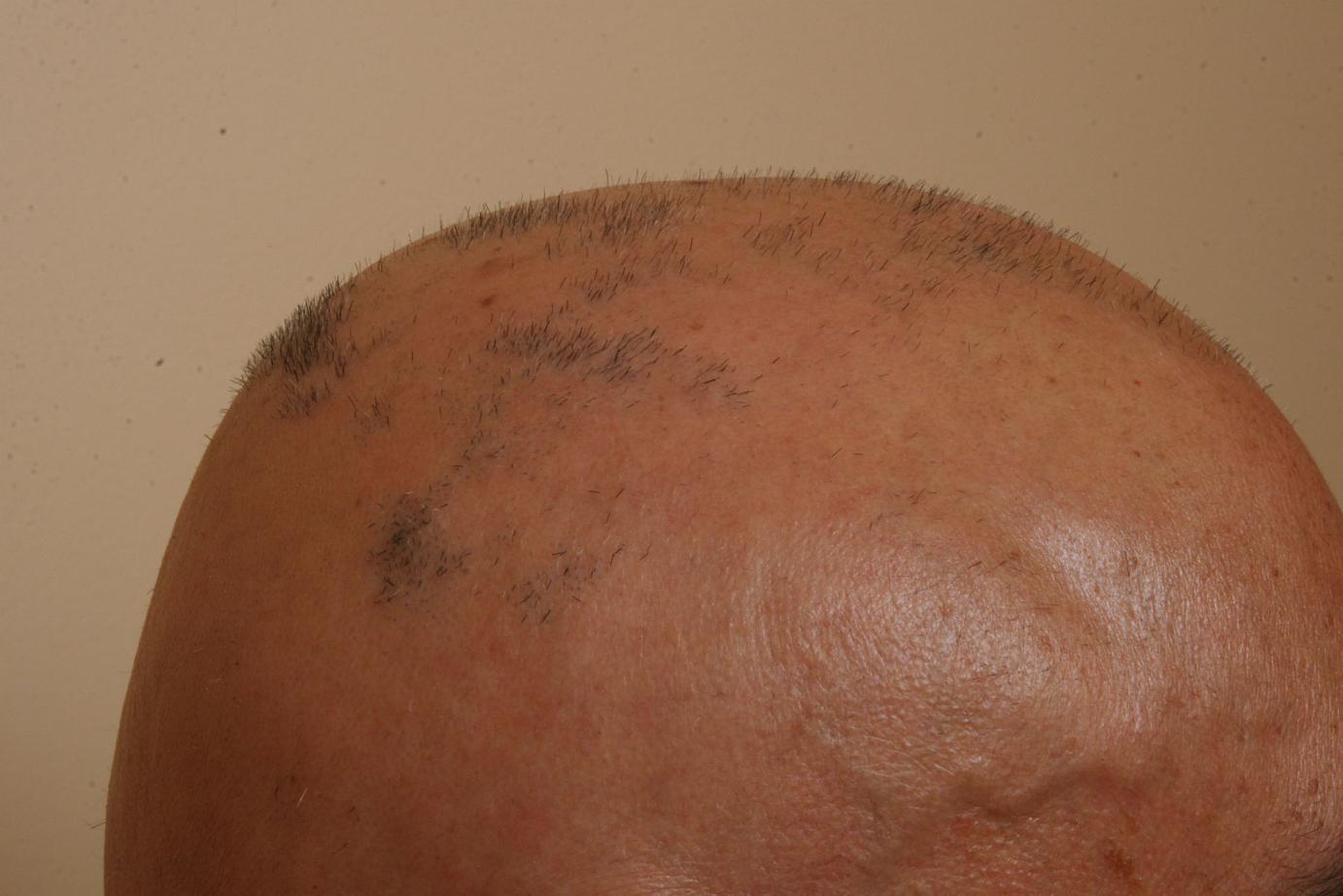
Although the hair loss is usually obvious, the underlying cause may take time to determine. Doctors will ask about social history to determine any life changes or new diets that can be contributing to hair loss. Often the reason for hair loss is simply older age.
If genetic, an individual cannot prevent hair loss. Male pattern baldness, originally believed to be passed down from the mother's grandfather, actually is contributed to by both parents. Maintaining a protein-rich diet and general health can reduce the occurrence of hair loss with old age. Some studies show that exercise may also increase the rate of hair growth.
Forms of hair loss related to diet or medical treatment usually reverse when the circumstances stop. Patients undergoing cancer treatment should ask their doctor if the medications will contribute to hair loss. Other problems such as fungal infections require anti-fungal drugs to kill the organism. Normal hair growth usually returns once the treatment is finished. A few new drugs for men that promote hair growth and reduce loss are finasteride, Propecia, and minoxidil. Women have their own set of hair treatment drugs which are, finasteride, Aldactone, and Tagamet. Both men and women may opt for surgical hair restoration which transplants another person's hair or an individual's own hair to the bald area. Non-surgical hair replacements, such as wigs, are also extremely common and might be the most affordable alternative.
American Hair Loss Association
23679 Calabasas Road # 682
Calabasas, CA 91301-1502
Hello,
I have hair loss starting many years ago. For the past 3 or 4 years I have been taking minoxidil (2.5mg orally) with great success. My hair grew back nice and thick. Now, all of a sudden, for the past 3 weeks I am experiencing excessive shedding. Strangely, it corresponds with my beginning a new batch of minoxidil pills. My usual CVS pharmacist had none in stock and had to call around to others to finally find some at another store. Is it possible that this is a dud batch of pills? The pills look the same, but unlike the previous batches that had a slightly bitter taste, these are tasteless. I can’t imagine why else my hair would suddenly start to shed. Thank you for any help.
Hair shedding starts 3 months after an emotionally or physically stressful event. I recommend that you look at life or health events that precede the new batch of medicine by 3 months.
Hello my name Is J.L. and I am a 34 year old African American male. When i was younger I have suffered with ringworm and it took my hair out and left me with a couple scars/ball spot in the middle of my head. For years I have been feeling self conscious about it and will like to see what options that are out there for my hair to grow back?
Thank you,
J.L.
I recommend evaluation by a hair restoration specialist. This specialist should be able to determine if hair grafting would be successful or the bald area is scarred and the scar better be surgically removed for best cosmetic results.
Hello,
my name is Dana. P. I’m 27 years old. few months I was so depressed and stressed, I was crying almost every day. I cant stop gaining and lose weight at the same time. my scalp is hurting me It is a sensation of fire.
This scalp pain appears to be a result of a complex medical or possibly psychosomatic issue. Please seak evaluation by a psychiatrist and your internist at the same time. They may involve a dermatologist if a scalp biopsy is needed.
Ive been to a dermatologist and they said I have alopecia but the hair comes back but not all of it. The problem is my scalp in the front is so red, until I put apple cidar vingar on it. My hair is so thin now. Can you help. I think its something else
I recommend that you seek a second opinion for your concern. Proper history, examination, and other analyses should allow to make a diagnosis and develop a treatment plan. This blog addresses general ideas and concepts but does not allow for an in depth consultation.
Have you treated lichen Planopilaris? I was told that it was possible I had this condition but have not had a biopsy. Would that be something you would do and are you accepting new patients
Lichen planopilaris is an inflammatory conditions capable of permanently destroying hair follicles on the scalp, in the brows and lashes. When treatment is started early and response to treatment is adequate, the inflammation and subsequent scar formation can be halted. We use a customized approach to treatment of lichen planopilaris. Our office accepts new patients.
If one suspects hair loss only began in the past six months and it hasn’t progressed to the point where anyone other than the patient suspects a change, would min+fin or just fin by itself stand a chance at regrowth?
Both, topical minocycline and oral finasteride/dutasteride, will induce regrowth in hair follicles that have entered miniaturization but have not fully atrophied. They can be used in combination or as single agents pending on possible side effects such as low blood pressure (minocycline) and loss of libido (finasteride /dutasteride).
I recently called to make an appointment for Melasma, but I also have a concern about hair loss. My hair is thin around the edges due to wearing weaves and also braided hair styles, but mostly due to too much estrogen being put into my body while wearing the birth control batch years ago and being emotionally stressed on top of that. I would like for my hair to grow back so that I can wear it naturally, have tried several items that suppose to regenerate hair growth, from store bought to natural remedies, nothing seems to work or I’m not noticing a quick change. I did go to a free consultation for hair loss and was informed that my follicles are clogged. So what can I do to help remedy this situation.
A dermatologist is the specialist who can help with both, melasma and hair loss. I recommend you reschedule the appointment that you missed.
I have really bad thinning of my edges on both sides due to years of tight sew in weaves and other hair styles that have caused great tension. In the last few years I have been very conscious of not wearing tight styles and have tried everything to get my edges to grow but they won’t. They are smooth and I know once the scalp is smooth like that, the hair will most likely not grow back. What are my options to getting my edges back and full again?
The scalp in the affected area has likely scarred due to repeated tension over several years. It is unlikely that hair will regrow if you have already provided a full vacation from tension in this area for a few years. The best option is hair transplant through micrografts.
I am 33 with my youngest child being a year and a half. I dealt with post partum hair loss with all three when they were around 4 months. The past two weeks I have noticed excess shedding and thinning around my hairline. The pharmacy changed brands of
Birth control on me 6 weeks ago so I am wondering if it is something related to that as nothing as changed in my diet or any other intake. I am somewhat stressed with three young children but I wouldn’t think to the point it would be taking a physical toll on my body. Any suggestions ? Thank you!
Both, the change in birth control as well as stress, might contribute to your hair shedding. Other causes might be considered. Proper evaluation and, if needed, biopsy by a dermatologist should help establish the diagnosis and treatment recommendations.
I’m a 27 year old African American woman experiencing thinning and hair breakage at the center of my head. It seems to be spreading outward. There are no spots of exposed skin. I have natural hair and do not use relaxers or any chemicals on my hair. After doing some research, I believe I have Central Centrifugal Cicatricial Alopecia. I was curious about the available tests and treatment options.
We confirm the diagnosis through skin biopsy that we sent for specialized scalp appropriate analysis. Treatment is individualized, yet basic treatment consists of monthly injectible or daily topical steroid as well as oral doxycycline for 9-12 months. Please schedule your appointment with Linda Heckman who is our office’s specialist in CCCP.