






Acne Scars - Patients ask, Dr. Ringpfeil answers
Please feel free to use the blog below to share information about Acne Scars or to ask Dr. Franziska Ringpfeil a question that might be of interest to others.
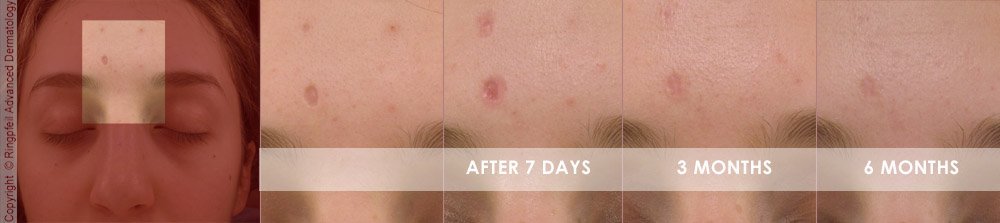
Combining PicoSure® laser with the new Infini high intensity fractionated RF micro-needling technology provides our patients incredible results that could not be achieved before.
Picosure stretches and softens the "knots" in the damaged scar tissue. The RF micro-needling treatment follows two weeks later, breaks the “knots” further and starts the process of collagen regeneration, which takes 3-6 months. The desired results are usually achieved in 2-4 treatments and downtime is minimal.
Results are visible 4 weeks after treatment, yet the scar surface becomes more even with the rest of the skin, and the overall skin texture improves to further reduce the contrast between the scar and the surrounding skin over the following 3-6 months.
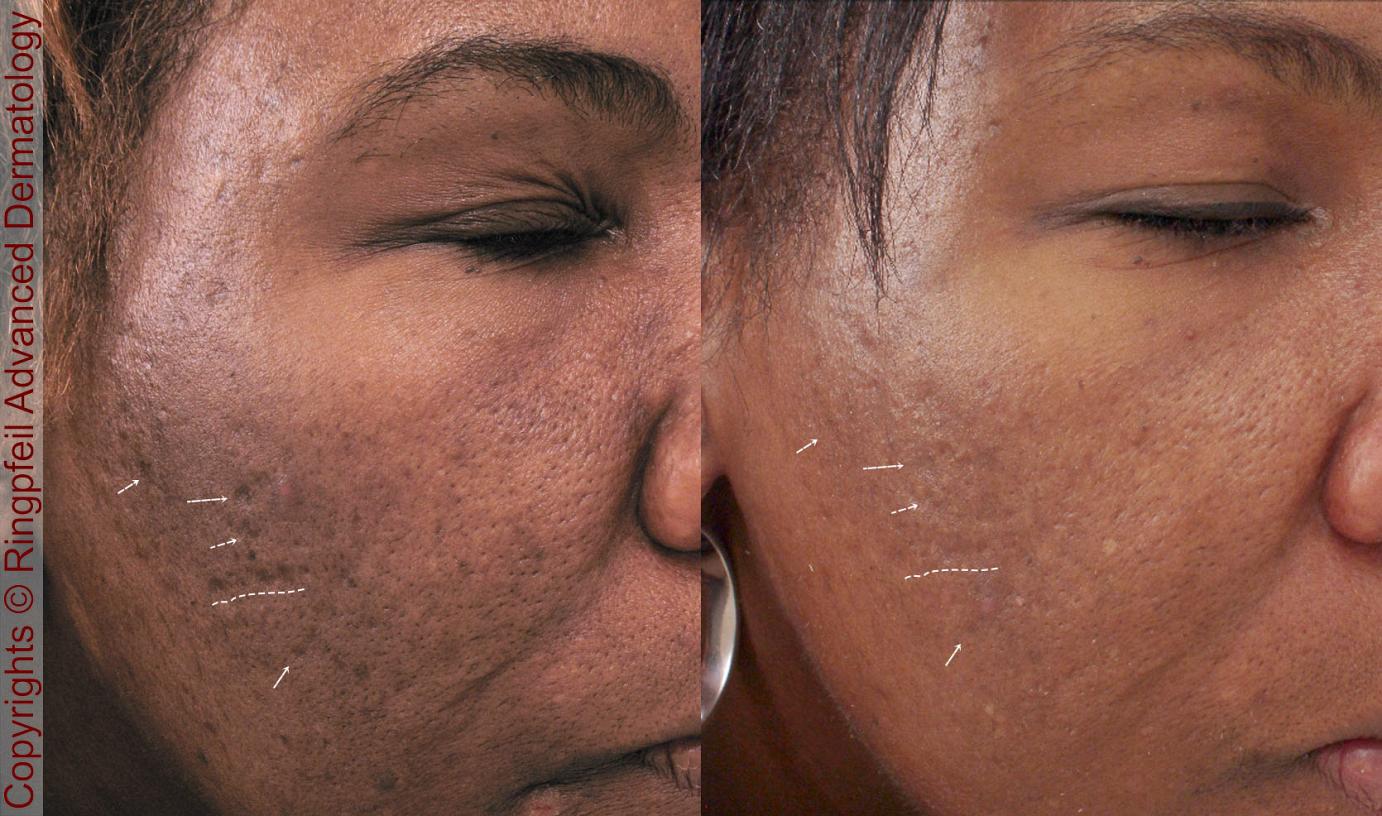
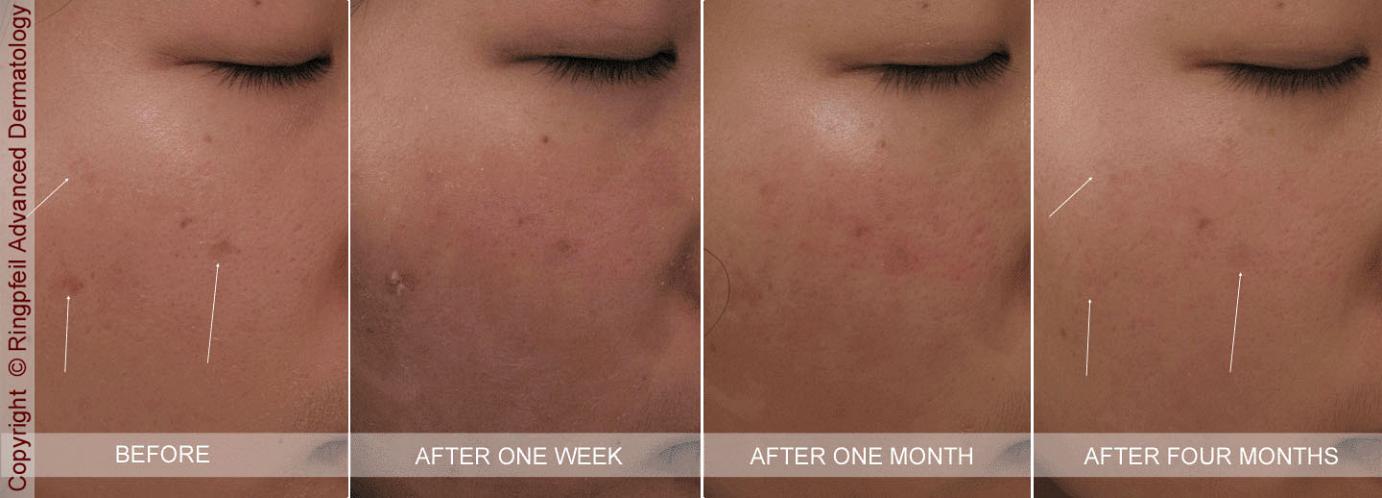
Scar treatments are among the core procedures performed at our practice.
To benefit the large number of our acne scar patients, we operate the most effective lasers for scar removal. Our experience enables us to combine lasers, punch grafts,photodynamic therapy, fillers and peel treatments to offer you the most efficacious and cost effective solution for your condition.
Book a consultation with Dr. Ringpfeil to learn what treatment plan is most suitable for you. This consultation is covered by most insurance plans.
| Infini RF | CO2 laser | Picosure laser | Fractional CO2 laser | Fraxel (TM) | TCA Peel | Photodynamic Therapy | Subcision | Fillers | Punch grafts | |
|---|---|---|---|---|---|---|---|---|---|---|
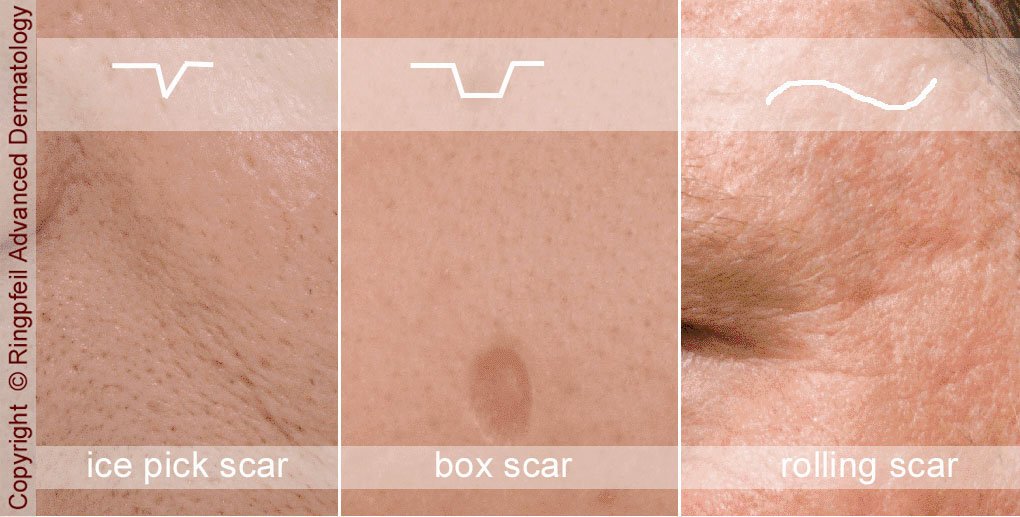
| Ice pick scar | + | +++ | + | ++ | + | +++ | - | - | - | ++ |
| Box scar | +++ | ++ | +++ | ++ | + | + | + | + | ++ | ++ (if small) |
| Rolling scar | +++ | + | +++ | + | + | - | + | +++ | - | - |
| Large pores | + | +++ | + | +++ | + | ++ | +++ | - | - | - |
| (uneven) Texture | +++ | +++ | +++ | +++ | + | ++ | +++ | - | - | - |
| Days downtime | 1-3 | 7-14 | 0 | 4-7 | 4-6 | 5-7 | 2 | 7-14 | 0 | 7 |
| # Treatments | 2-3 | 1-2 | 3-4 | 1-2 | 4-8 | 1 | 4-6 | 1 | 1 | 1 |
| Lasting results | permanent | permanent | permanent | permanent | permanent | 1-2 years | permanent | permanent | 6-18 months | permanent |
| Total Price | $1500-$2000 | $3000-$6000 | $3000-$4000 | $1500-$2000 | $4000-$6000 | $500 | $2000-$3000 | $500 | $300-$800 | $185-$2000 |
True acne scars can only be improved by removing the top layers of the skin and letting the skin build a new surface, combined with maximum collagen production from underneath. This can be best achieved by CO2 laser resurfacing. The laser assures precise depth of abrasion, thereby minimizing complications that were common with dermabrasion (not microdermabrasion), such as permanent pigment change.
Deep pitted scars require punch grafts 4-6 weeks prior to the laser procedure for maximum fill. Nowadays, fillers can be used to bolster scars. Often, acne scars may be preventable if acne treatment is started early.
I have a hypertrophic scar on my nose – what are common treatment options? I have tried steroid injections and they help but it just pops back up after a month
Hypertrophic scars on the the nose can flatten with a brief series of fractionated non-ablative laser treatments every 4 weeks, e.g. 1540 nm laser.
I am looking to have subcision performed, could
You tell me a little about it and who performs this procedure at your practice and their experience level? Thanks.
Subcision is a long-established technique to break up scar tissue using a needle, other cutting device, or even a laser under the skin. It works well for rolling scars and also for individual deep box scars. The procedure is performed under local anesthesia and sterile conditions. Swelling for several days and bruising for a up to 3 weeks is an expected side effect. Infection is rare and will require antibiotic. I am the only one who performs this procedure in our office, and I use the needle technique. As you are probably aware, our practice focuses on scar treatment of many types, and we always customize treatment to the need, skin type, skin color and abilty to have downtime of our patients. I have treated many patients in whom subcision was appropriate over the past 27 years.
Hi. Not sure if this is answered somewhere on the site, but how long does it usually take for a new patient to set up a consultation and start treatments?
You may set up a complimentary pre-screening consultation with our aestheticians, which is usually possible within days. If you have the most common type, namely box scars, treatment could start soon after your consultation. If a full medical consultation with our dermatologists is needed, treatment can still begin within a few days after the consultation. For your convenience, you may schedule online with our aestheticians. If you prefer medical consultation form the start, please choose Dr Hannaway in Center City or me in Haverford.
I appreciate your quick response! Unfortunately I just finished my course of Isotretinoin in March, and I’ve been told not to seek scar revision treatment until September at the earliest 🙁
Sidenote — the treatment options chart above doesn’t have Microneedling on it, does that mean your practice doesn’t offer this treatment?
Many studies have been performed over the past few years that have looked at safety of laser or device treatment of skin after isotretinoin completion. Treatments that do not temper with the epidermis can safely be performed one month after completion. these include non-abalative fractionated resurfacing with 1540 and 1550 nm lasers, laser hair reduction, laser treatment of redness, Nd:YAG laser treatment of hyperptrophic scars, pisocsecond laser treatment for scars and skin tightening. Methods that injure the epidermis (CO2 laser, fractionated radiofrequency, subcision, open surgery) can be performed 6 months after completion of isotretinoin course, although some may already be able to tolerate it 3 months after. In our office, the decision is made on an individual basis, considering many factors. Microneedling is a popular spa treatment without lasting results. We do not offer this treatment. Fractionated radiofrequency is powerful treatment for atrophic box scars and rolling scars. It is delivered via microneedles but this treatment is not related to microneedling.
Do you provide treatment for steatocystoma?
Steatocytoma is a benign condition and can be part of a genetic complex. We perform excision for steatocystoma that are large, actively growing or in obvious locations. CO2 laser is less efficacious than excision but can be used when many steaotocystomas are desired to be removed and skin is fair in color.
Hello,
Is there a way to treat a scar after a tummy tuck? I heard there are steroid injections to flatten it and lasers to remove it, do you perform that? Thanks
Yes, we do treat raised scars with injections and laser, and we can improve flat scars with laser, too. Please set up your consultation with any of our dermatologists.
I have about a 3 1/2 scar on my left shoulder from labrum surgery in 1994. Just wanted to know what treatment is available just to smooth it out a bit. I am having a large tattoo placed over it to hide it. How much will this cost me?
Thanks much
If it is a hypertrophic scar or keloid, it can be treated with laser and injections in this location. Hypertrophic scars flatten after just a few monthly treatments, keloids can take several months. Treatment for raised scars can often be submitted to insurance. The cost to you then depends on copay, co-insurnace or deductible requirements of your plan. If you do not carry insurance, we can provide treatment cost to you according to our self pay schedule after in person examination of the scar.
Hi, Dr. Ringpfeil. I am a long-time patient and I was doing a little homework on a topical medication containing the active ingredient in Accutane called ISOTREXIN. This topical medication also includes erythromycin. I would like to know if you are familiar with it and know if such a product is available. It would seem like a really good option for those who want to avoid the systemic use of isotretinoin.
Your isngights would be appreciated.
Thanks,
Joe
Topic retinoids contain tretinoin, a cousin to isotretinoin. A combination product that contains and tretinoin and clindamycin (a cousin of erythromycin) is availble under the trade names Ziana and Veltin. Our office offers an FDA pharmacy-compounded product that contains tretinoin, clindamycin and soldiumsulfacetamide for even greater convenience.
Neither of these topical products are equivalent to isotretinoin but they certainly work very well in individuals with mild to moderate acne.
Hello,
Doctors in Asia are using Sodium DNA / PDRN injection to treat scars nowadays. They are getting amazing results. Please look into it. Thanks
Hi-
I have Hidradenitis Suppurativa and the scars that come with it, unfortunately. Is there anything available to reduce them? and id so, what is the time frame for seeing reduction? I am getting married in October 2019 (yay!) and would love to not be hindered by my scars.
Thank you!
Scar treatment in hidradenitis is no trivial task. Scars can be atrophic or hypertrophic pending disease severity. The hypertrophic ones often contain sinus tracts from where repeat drainage occurs in active disease. Marsupialization is the removal of a single sinus tract. It typically trades a thick scar with a flat scar. It is possible that surgical or laser based single scar revision flares up hidradenitis suppurativa. Atrophic scars are not usually treated as the risk of flare outweighs the benefit. The only treatment that does not go along with the risk of flare is complete resection of the affected hair bearing area. This is an extensive procedure with significant recovery time. Some surgeons graft the resected areas, others leave it to heal naturally. The latter is more common when CO2 laser is used as the cutting tool. Untimely, the grafting decision is also based on location and specific anatomy.
Nd:YAG laser treatment is available for hidradenitis affected areas and especially for sinus tracts, and it can quiet active hidradenitis suppurativa. Laser hair reduction with Nd:YAG or alexandrite lasers is used to prevent new areas of inflammation. Neither of these 2 latter treatments affect the appearance of existing scars.
Some people might choose marsupialization of very prominent sinus tracts and Nd:YAG laser treatments of less prominent sinus tracts. Please schedule a consultation for your scars with me so that I can advise you of your options.
I have hypo pigmentation from a laser treatment years ago. Is there anything that can be done to restore pigmentation?
Hypopigmentation does not respond easily to treatment. Sometimes, options are available to better blend the hypopigmented areas. Please set up a consultation.